







“Movements of Fire and Shadow”
Written by J. Michael Staczynski
Directed by John C. Flinn III
Season 5, Episode 17
Production episode 518
Original air date: June 17, 1998
It was the dawn of the third age… Lochley records a log entry bringing everyone up to speed on how ugly the IA-Centauri war is going. Of note is that Centauri citizens on B5 are being targeted for retaliatory assault by, basically, everyone. Sheridan arrives to bring her up to speed: the Centauri are targeting jumpgates. This is an insane strategy, as it’ll hurt the Centauri also, but here we are. Sheridan also tells her that he’s mobilizing the White Star fleet to supplement the IA forces, which means that B5 will now be a target.
Sheridan and Delenn discuss the White Star fleet, which has been diminished by three conflicts in two years. They need to build more. President Luchenko has agreed to the possibility of a joint Earth-Minbari venture to construct Destroyer-class White Stars, but only if the Minbari are agreeable. Delenn agrees to travel to the Grey Council to discuss it.
Vir meets with Franklin and Alexander in his temporary quarters, as his real quarters aren’t safe. The Drazi haven’t returned the bodies of Centauri who’ve been killed in action. He’s concerned that they’re not actually dead and being held prisoner, or that maybe something else is going on. Franklin agrees to go in his capacity as a doctor; Alexander agrees to go as telepathic backup for 500,000 credits. Vir blanches, but agrees to her higher-than-usual fee.
On Centauri Prime, G’Kar urges Mollari to leave the cell, but Mollari thinks that him being in the cell is more useful as a propaganda tool. Once the people learn that he’s been imprisoned, there will be outrage.
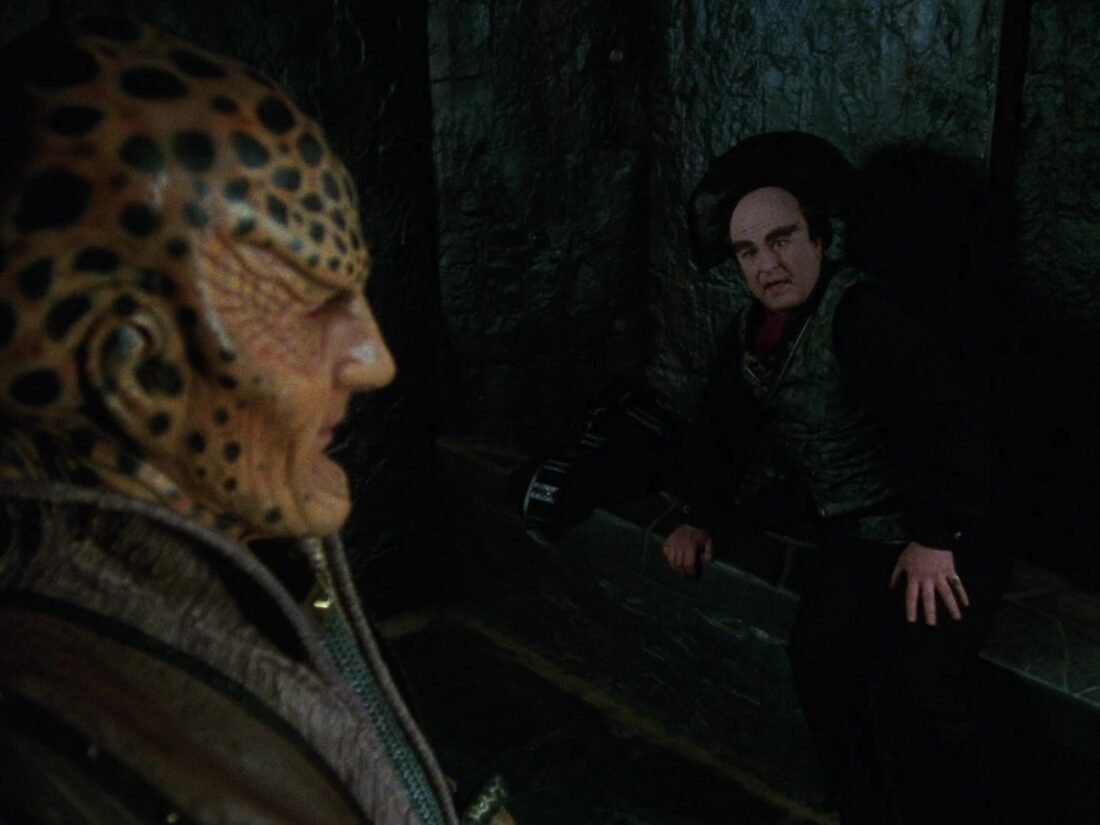
A bright light renders them both unconscious, and Mollari is wheeled to a lab where he’s operated on by aliens. Then he wakes up—apparently, it was a dream. However, Centauri often have prophetic dreams, and now he feels he does need to get out of the cell—but he can’t just demand it, he needs to save face. G’Kar helps him out by inducing vomiting, thus creating an intolerable nasal situation in the cell.
On B5, Sheridan, Lochley, and Garibaldi meet with generals from the Brakiri, Drazi, and Narn. They are all grateful for the White Star support. However, they all reject the notion Lochley proposes of them consolidating their forces. When Sheridan asks about the Centauri’s tactics, with Garibaldi adding that they seem to have a two-pronged strategy: one set of ships on offense, one set of ships on defense, and the two fleets don’t seem to be coordinating or even communicating. Na’Tok, the Narn general, says that this is very atypical of the Centauri, and further admits that the goal of their strategy is not at all clear. Sheridan then rejects Na’Tok’s suggestion of striking Centauri Prime, as that’s a civilian target, not a military one.
Lochley is summoned to CnC, and is told by Corwin that there’s a lone Centauri cruiser in hyperspace with no life signs, and no weapons active. Lochley orders the Starfuries they have parked in hyperspace to destroy the ship, which happens right before the Centauri ship was going to self-destruct, destroying B5’s jumpgate.
Observing this, Daro, the Drazi general, approaches Na’Tok about ignoring Sheridan’s directive and attacking Centauri Prime. Na’Tok agrees.
On Centauri Prime, Mollari meets with several ministers, Cholini among them, insisting that the Regent is unreliable and endangering Centauri lives. Cholini, however, continues to toe the party line that the Centauri are not responsible for the attacks, and they have only been defending themselves.
On B5, Garibaldi learns of the planned Drazi-Narn invasion of Centauri Prime. When he informs Sheridan of this, the president hops into a White Star to try to stop them.
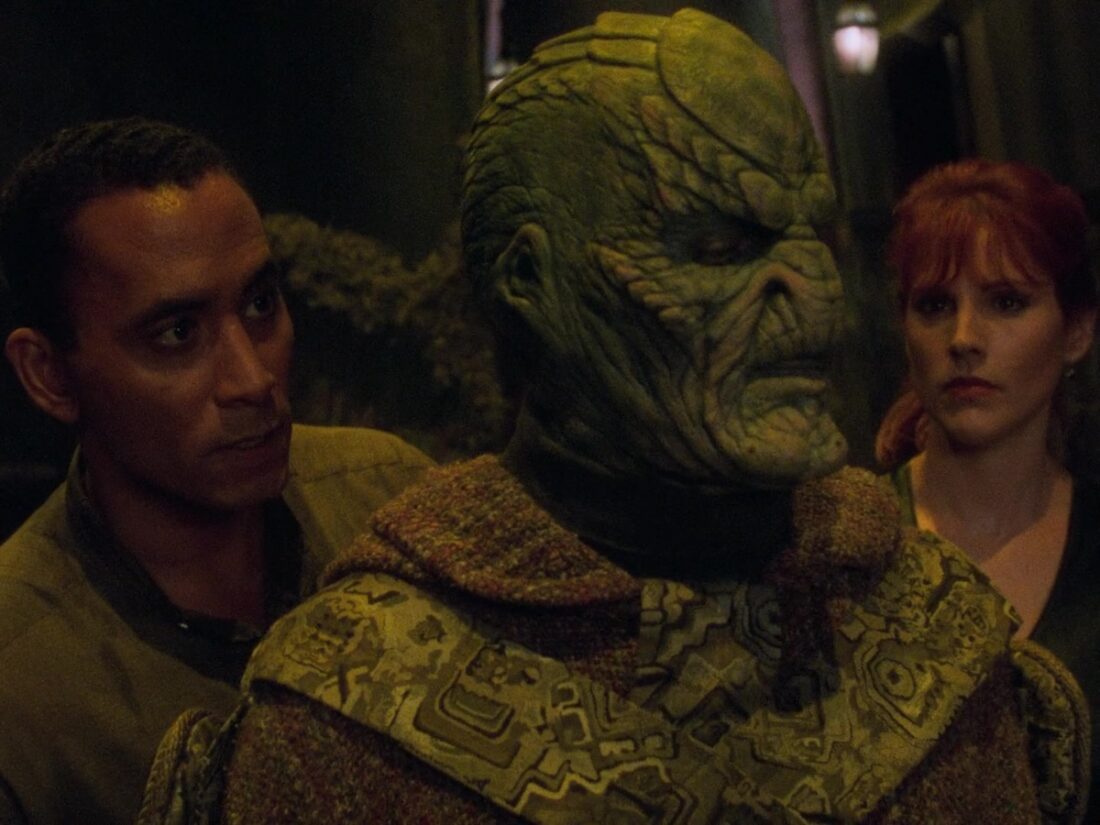
On Zhabar, the Drazi homeworld, Franklin and Alexander meet with a doctor who insists there are no Centauri bodies. They’re then jumped by two other Drazi, but Franklin takes down one, and Alexander rather nastily takes down the other. She then gets a location from the now-frightened doctor’s mind and demands that they be taken there. They find a room full of pods that Alexander recognizes as being Shadow tech that can remotely control a ship—you wouldn’t even need a crew. They report this to Sheridan, who realizes that there may be a third party involved here, one that is setting up the Centauri for a fall.
In hyperspace, Delenn’s White Star is ambushed by four Centauri warships. The ship is badly damaged, with all of the crew killed save for Delenn and Lennier, because they’re opening-credits regulars. They’re drifting, Lennier isn’t sure if the distress call is working, and eventually they’ll drift off the beacon and be lost in hyperspace.
On Centauri Prime, Mollari finds the Regent waiting for him in his quarters. He confirms that he ordered the attacks “after a fashion,” without informing the Centaurum, which is why Cholini believes that they’re being framed. Cholini is only partly right. The Regent says that he is looking forward to death, saying that it’ll be Mollari’s time soon. Mollari insists that the Regent has a long life ahead, but the Regent says he’ll be dead the following day. And one of his final acts has been to send the fleet defending Centauri Prime off on a fake emergency and shutting down the planetary defenses—just in time for the Narn/Drazi fleet to start firing on Centauri Prime…
Get the hell out of our galaxy! Sheridan finally is able to put together what’s happening, and also proves to be completely ineffectual as the leader of the IA, as the Drazi and Narn ignore his orders with impunity and malice aforethought.
Never work with your ex. Lochley has been conspicuous by her absence the last few episodes, so it’s good to see the actual commander of the fershlugginer station here. If nothing else, she should’ve been part of the council meetings as representing Earth, which Sheridan can’t do, as he’s president of the whole alliance—besides which, B5’s structure has had its CO also be Earth’s rep on the council from day one. But that would’ve required paying for another actor these past few episodes…
The household god of frustration. Garibaldi manages to stay awake for the whole episode. Bully for him.
If you value your lives, be somewhere else. Delenn apparently got a gift from Sheridan that she refuses to wear, as we’re informed in one of those patented hey-look-it’s-funny! attempts at humor that J. Michael Straczynski occasionally tortures us with.

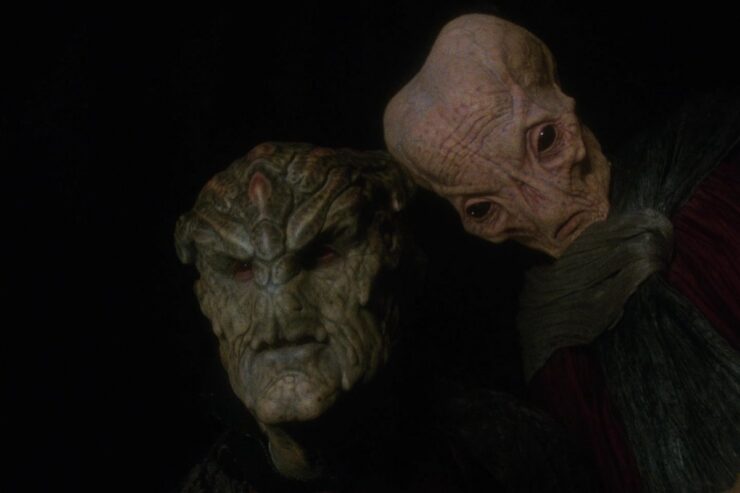
In the glorious days of the Centauri Republic… The Drakh are setting up Centauri Prime for a fall, in part by making them think that they’re not responsible for the attacks when they totally are (kind of).
Though it take a thousand years, we will be free. Apparently, G’Kar can induce vomiting and said vomit is very stinky.
The Corps is mother, the Corps is father. Alexander isn’t screwing around—she needs capital to help her fellow telepaths out, so she’s charging a lot more for her services. She does, however, try to soften the blow with Vir by saying he can view it as a charitable donation.
The Shadowy Vorlons. The Drakh are using Shadow tech to manipulate the Centauri, which is also a classic Shadow strategy of divide and conquer.
Welcome aboard. We’ve got recurring regulars! Damian London is back from “In the Kingdom of the Blind” as the Regent, next (and last) to appear next time in “The Fall of Centauri Prime.” Joshua Cox is back from “Day of the Dead” as Corwin, next to appear in “Objects at Rest.” And Thomas MacGreevy is back from “And All My Dreams, Torn Asunder” for his last appearance as Cholini.
We’ve got actors in one of their many roles! Wayne Alexander plays his fifth role as the Drakh, a role he’ll return to next time in “The Fall of Centauri Prime.” He previously played Sebastian in “Comes the Inquisitor,” G’Dan in “And the Rock Cried Out, No Hiding Place,” the Drazi “prisoner” in “Intersections in Real Time,” and the recurring role of Lorien in the first half of season four. Robin Sachs plays his third role as Na’Tok, a role he will also return to next episode. He previously played Hedronn in “Points of Departure” and “All Alone in the Night” and Na’Kal in “The Fall of Night” and “Walkabout.” Bart McCarthy plays his second role as Daro, having played Shakiri in “Moments of Transition.” Josh Clark plays his first of two roles as Kulomani; he’ll play Kendarr in Crusade’s “Visitors from Down the Street.”
Trivial matters. The Regent had promised Mollari that they’d talk once more before the end in “In the Kingdom of the Blind.”
This episode establishes that Luchenko—who was made acting president in “Rising Star” after Clark’s suicide in “Endgame”—is now the really-o-truly-o president of Earth.
Just as in prior seasons, the final four episodes were held until the fall. This episode ended on the rather nasty visual of Centauri Prime being bombarded, with what was happening next not to be shown for four months. However, to tide viewers over, the movie Thirdspace—which takes place during the fourth season—was aired in July. (We’ll cover all four of TNT’s B5 films after season five is complete, and before we start with Crusade.)
The echoes of all of our conversations.
“You picked a terrible moment in your social evolution to develop principles. Perhaps you can start with something simpler—the moral equivalent of the opposable thumb, for instance?”
—G’Kar on Mollari insisting on staying in the cell with him
The name of the place is Babylon 5. “The last thing I will ever have to do for them.” It’s been fascinating going through season five of the show, because while I have pretty clear memories of what happened in the first four seasons, I recall damn little of season five. (Amusingly, two things I have kept in my head clearly are Byron’s singalong at the end of “Strange Relations” and Garibaldi drunkenly singing “Show Me the Way to Go Home” at the end of “Meditations on the Abyss.”)
So I was genuinely caught off-guard when I realized that Cholini’s outrage at the Centauri being accused of attacking defenseless cargo ships wasn’t manufactured. He genuinely believed that his people were being framed and that this was all propaganda—which it was, but from inside rather than outside. Cholini’s still a slimy piece of work, but the revelation that the ships that have been attacking have been remote-controlled by the Drakh hits beautifully. It explains why those ships never communicated with their victims, and also why they seem to have independent offensive and defensive strategies.
(It doesn’t explain how there’s no record of what happened during those attacks, as apparently black-box technology has disappeared from the entire galaxy over the centuries between the present and B5’s future. Also, why didn’t Lennier notice that there were no people on board the ship he attached himself to like a leech in “Darkness Ascending”?)
Sheridan continues to suck at his job, as it’s obvious that none of the three generals he meets with have any respect for him as a leader—they just humor him because he controls the White Stars, and they need those. While there is sometimes a tendency on this show to insist to us that characters are competent when they’re not, I think that Sheridan’s impotence as president of the IA is a deliberate—and impressive, given that this is our lead we’re talking about—choice on the part of J. Michael Straczynski. Bruce Boxleitner also sells the character’s annoyance and frustration, both with his allies and his enemies.
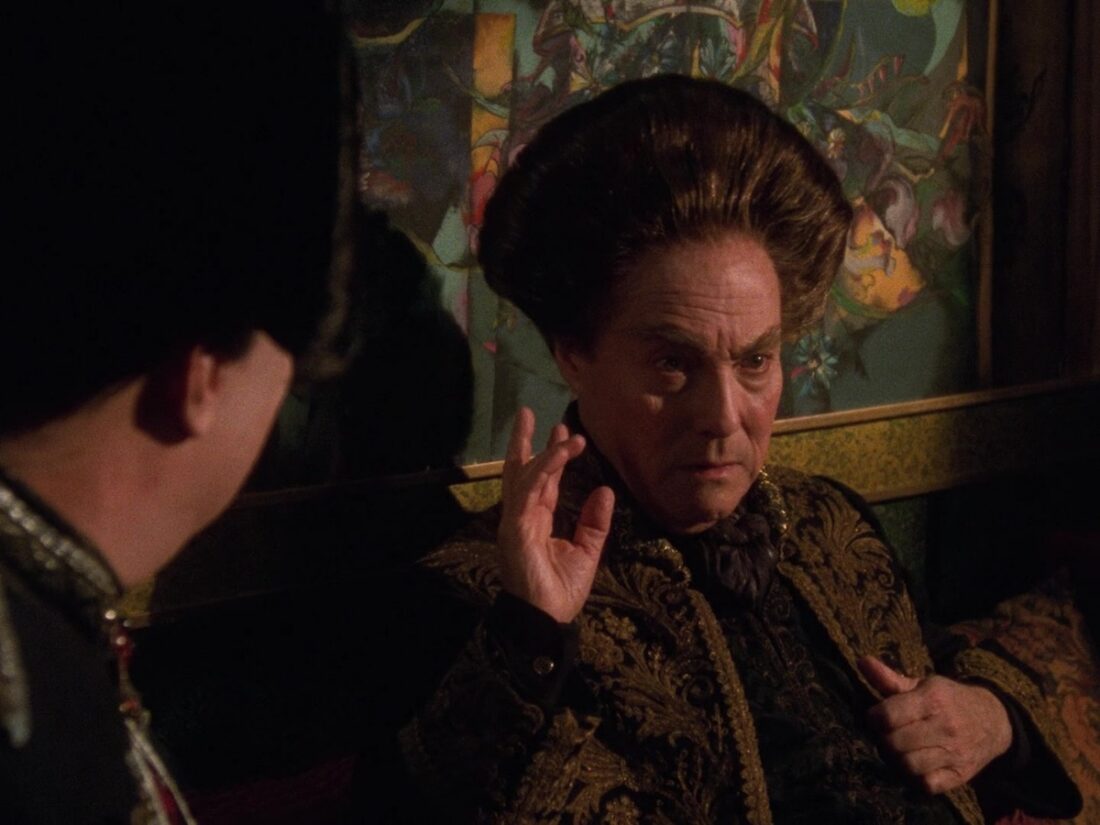
The stuff on Centauri Prime continues to be the show’s best material, due in part to the usual brilliance of Andreas Katsulas and Peter Jurasik, but mainly this time around because of how Damian London absolutely kills it. London’s Virini has had to be many things on this show, generally being whatever flavor of obdurate bureaucrat and/or aristocratic toady is required of him. But his talk with Mollari at the end of the episode is devastating. It’s the same high-pitched squeal that London has been using for the character all along, but it’s slower, more intense, more monotone, and scary as hell. London perfectly shows the character’s helplessness and awareness of how pathetic and broken he is.
Plus, if you need a character who can show tremendous emotion and nastiness just by tilting his head, you can always count on Wayne Alexander, who quietly imbues the Drakh with total menace.
Next week: “The Fall of Centauri Prime.”

Also, how the heck does the Centauri Fleet not notice that half the fleet is running around without their crews?
They addressed that — the Regent and a few high-placed officers were able to arrange it and cover it up from the rest. It’s probably pretty easy to run a conspiracy in a monarchy if the acting monarch is the one directing it.
Even though the seams show a bit here and there, I really like this episode. It feels like so much of what has been put into place previously this season, especially since “In the Kingdom of the Blind”, starts to fall together, from the nature of the Centauri attacks to the strain within the Alliance to Lyta’s radicalization. And as Keith mentions, the scenes on Centauri Prime are stellar, particularly those end scenes with Londo and the Regent.
My biggest gripe is with the subplot with Delenn. It makes no sense to send Delenn to Minbar in a single White Star, even accounting for the relatively small number of remaining White Stars. At the very least, she ought to have an escort of some kind, given the fact that they are in the middle of a war! The nature of Delenn’s mission could still be secret, after all. The escorts need only be told that Delenn needs to return to Minbar. But then it wouldn’t set up the moment between Delenn and Lennier in the next episode…
I’m really impressed with Damian London. He took a character that was a stereotype that hasn’t aged well and made him incredibly tragic. What really struck me though is the way his right hand is constantly hovering between his head and shoulder, hinting at the Keeper, at a desire and a fear of touching it to confirm it’s really there.
Delenn and Lennier aren’t the only survivors, just the only ones on the bridge. Lennier says something about survivors on other decks who can’t get past wreckage when he’s filling Delenn in on the situation after she comes to.
I agree, Damian London did an excellent job as Virini. My watch group recently showed his first appearance and there’s such a difference between his brightness in that moment and his bleakness here, yet it’s still clearly the same character. I can’t help but feel bad for him, even though he’s an (unwilling) accomplice to evil. Kudos to the actor.
True, but either way, it comes off as an alternate way of pronouncing “We didn’t want to pay for more extras.”
I didn’t really see the war council scenes as evidence of Sheridan’s incompetence, just at JMS’s refusal to write the Drazi and other second-tier species as anything but one-note violent obstructionists who constantly need the human savior character to lecture them on the kind of morality that humans seem uniquely capable of conceiving — your classic White Man’s Burden narrative transposed to outer space, which was all too common in 20th-century science fiction. The Drazi have never been anything but straw men, and being irrational and obstructionist is their only defined role in the series. So of course they act in the stereotyped way, irrespective of the president’s competency. I’ve really gotten sick of what a caricature they are.
For me, the high points were London’s scene as the Regent and the bombing attempt on the jumpgate, which revealed one or two details about jumpgate operation that I don’t think we’ve seen onscreen before.
Somewhat but not entirely fair. The Brakiri representative here is more cynical than belligerant and no part of the later attack. The reason a Narn might have for wanting to hit Centauri Prime is obvious, and two years ago the Centauri were at war with the Drazi as well. Na’tok is clearly troubled by the change in Centauri tactics but eager to take action.
As for the Drazi, they do get depicted in more stereotypical ways, but the episode goes out of its way to characterize their motives as more than belligerance and revenge. Aside from their subterfuge with collecting the Shadow tech (they clearly know more of what is going on and are being opportunistic), we get this motive from Franklin: “And the Drazi wouldn’t tell anyone about these things because they’ve always competed for trade with the Centauri, so a war is in their best interest.”
If anything, it’s Sheridan naively believing the Narn and Drazi will show restraint because he as great White savior told them to that’s presented as a mistake here. We can already see his error in the same scene he commits it. And Na’toth’s logic for supporting the attack is distinct from the Drazi motive as presented, so there’s some characterization at work.
It may have been a disaster, but I regret not getting more of Legend of the Rangers because Turk, Drazi Ranger obviously being established as stupid strong comic relief was clearly going to turn out to be smart, just undereducated, belittled, and with limited English skills at first. We get distinct Centauri and Narn and Minbari characters but little development of the secondary species (with the Markab a brief exception). This is still better than the Llort, Gaim, Hyach, Abbai, Vree, or pak’ma’ra get, though.
Revenge or subterfuge, it’s still part of the same pattern of always writing the Drazi as unreasonable troublemakers.
A harrowing episode, suffice to say. We’re right back to the way things were in the end of season 3, beginning of season 4. Credit to the Drakh, they pulled everyone’s strings from the beginning, and managed to stay hidden for this long. There’s also this impending sense of inescapable doom that you feel desperate to find any solution or loophole to get out of, and you just can’t. You’re just trapped along for the ride. That final scene with the Regent is just devastating. You feel as frightened as Londo. That final shot of the Narn and Drazi fleets opening fire is simply terrifying. And it was probably so to the innocent Centauri civilians just as much as the sightings of the bombers must have been to the Japanese citizens of Hiroshima and Nagasaki in August of 1945.
We know what happens to the Centauri as seen in Sheridan’s future glimpse from “War Without End”. That future is set, and this is a major step towards it.
That Virini is such a subversion of an old stereotype is actually very similar to how Londo first debuted back in the pilot. He was also the cartoony boisterous drunken gambler, until we got to really know him and peel every layer, finding out just how tragic he was. Virini is the same. The palace clown who turned out to be a useful village idiot placed in a position of power, to then find himself just as powerless and lacking control over his destiny (exactly as Londo’s own arc).
Looking at the Drakh strategy, what surprises me isn’t that they are targeting jumpgates – it’s that the Shadows apparently never did. It illustrates the biggest difference between the Shadows and their underlings: the Shadows were violent and destructive, but were still willing to pull their punches in order to teach their lessons to the younger races in order for them to evolve. The Drakh have no such goals. They are acting out of spite and revenge, and targeting vital interstellar infrastructure is fair game.
And while the Byron arc dragged the season down, I do give it credit for giving us this updated version of Lyta. She’s the one telepath you want at your side, while you hope never to upset or double-cross her in any way. Hers is a nasty case of violence on the job. It’s ironic that she now happens to be the poster child for everything humanity worries about when it comes to not trusting telepaths, validating the Psi Corps in the process, even though they are the biggest reason she became this radical extremist.
The one minor issue with the episode is without a doubt sending Delenn and Lennier on a hyperspace trip with a single ship – a plot setup clearly designed for a near-fatal assault that will leave the two of them alone together for that intimate moment we’re all waiting for. There’s no problem in plot being secondary to character, but this one needed a couple more rewrites for the plot to hold up better. At the very least a small White Star escort to mask the fact that this is a plot device. And while we don’t yet know Lennier’s outcome, we do know Delenn survives to old age till 2362. So, doing a jeopardy plot with them feels a bit pointless.
“And it was probably so to the innocent Centauri civilians just as much as the sightings of the bombers must have been to the Japanese citizens of Hiroshima and Nagasaki in August of 1945.”
Not exactly, because IIRC, Centauri Prime has not been bombarded prior to this. People tend to forget that most of Japan’s cities (along with many of Europe’s) had already been devastated by conventional firebombings well before August 1945; the atomic bombs were just a more efficient way of doing what was already a standard tactic. (See, for instance, the ruins of Tokyo in the first act of Godzilla Minus One.) So the citizens of Japan were probably well aware of the risk of their cities being bombed, just not in that particular way. If anything, the small bomber squadrons sent to Hiroshima and Nagasaki, just 6-7 planes, would have looked far less intimidating on approach than the squadrons of dozens of bombers that had previously devastated so many other Japanese and European cities.
And contrary to myth, the atom bombs had no effect on the Imperial government’s war plans; it was actually the USSR’s declaration of war against Japan on August 8 that forced their surrender because they couldn’t handle a ground invasion on two fronts as opposed to just one. They just pretended the atomic bombings had shocked them into surrender to save face, and to avoid admitting that they’d been perfectly willing to sacrifice far more of their citizens’ lives and cities.
“And while we don’t yet know Lennier’s outcome, we do know Delenn survives to old age till 2362. So, doing a jeopardy plot with them feels a bit pointless.”
I’ve never understood that argument. If knowing the outcome rendered jeopardy pointless, there’d be no point to rereading or rewatching a story you already knew. I mean, after all, we know they’re imaginary and nobody’s actually in danger, but we choose to suspend disbelief and convince ourselves there’s actually someone’s life at stake. It’s no different to suspend disbelief and pretend you don’t already know the character’s future. After all, the characters don’t know the outcome, and if we can choose to identify with them enough to care about them even though they don’t exist, then we can choose to identify with their fear about their fate. It’s not about what you know, it’s about what you let yourself feel.
And contrary to myth, the atom bombs had no effect on the Imperial government’s war plans; it was actually the USSR’s declaration of war against Japan on August 8 that forced their surrender because they couldn’t handle a ground invasion on two fronts as opposed to just one.
A very good point. I’d overlooked the Soviets in the Japanese side of the war. Their efforts always count, much like their major role in bringing Germany down.
I’ve never understood that argument. If knowing the outcome rendered jeopardy pointless, there’d be no point to rereading or rewatching a story you already knew.
I didn’t say it was pointless. I said it felt pointless. But I get the reasoning. And to be fair, we do care about Lennier’s and Delenn’s feelings enough to care about how they deal with this perilous situation, especially Lennier’s unresolved and unrequited feelings towards her.
I would add, also, that JMS chose to reveal certain things in advance about the future of these characters, going as far back as telling us in season 1 how Londo and G’Kar would eventually die decades into the future. Foreshadowing has always been part of JMS’s toolkit. Knowledge of a character’s future survival doesn’t spoil the intended impact if the writer chose to give us that knowledge, if it was an intentional part of the plan. JMS would’ve written these scenes knowing that we know the main characters would survive it, so suspense over whether they would die was never, ever the point. There are so many other things besides death that are important in a character’s journey and can create suspense. Even if we know where a character will end up, there’s still a lot we don’t know about how they got there and what happened in between.